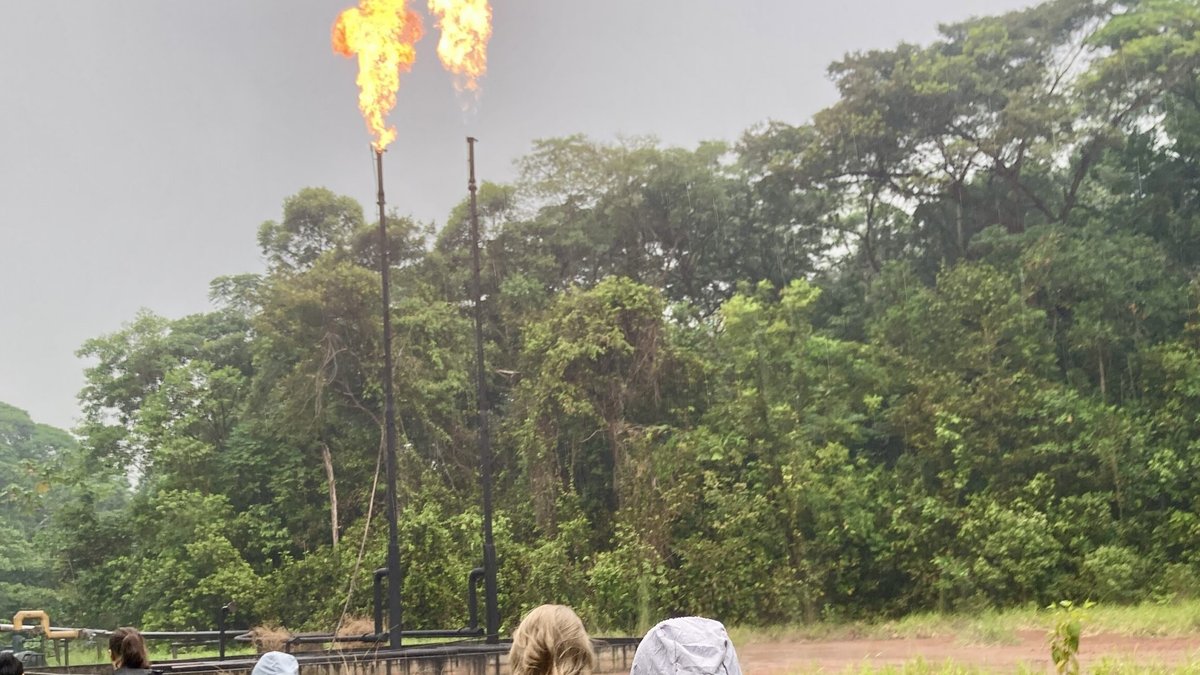
Nine girls from the Ecuadorian Amazon have spent years advocating to halt more than 400 gas flares burning near their communities. A coalition of law professors and scholars—supported by UCLA’s Human Rights Litigation Clinic and Environmental Law Clinic—has now submitted an amicus brief urging Ecuador’s Constitutional Court to enforce a 2021 ruling that demanded the elimination of these flares by 2030.
The lawsuit, known as Herrera Carrion v. Ministry of the Environment or gas flaring (a practice referred to as mecheros-Spanish for “the flares”), challenges a widespread practice in Ecuador’s oil industry: instead of capturing or commercializing natural gas released during extraction, companies release it through open flames. The practice releases large quantities of carbon dioxide, methane, and toxic carcinogens like benzene into the air. Research connects these emissions to breathing disorders, reproductive damage, and-according to some studies-higher cancer risks.
The plaintiffs, assisted by UDAPT, an Indigenous-led advocacy group, initially lost their case in 2020 but won an appeal the following year. The court ordered the elimination of gas flares near population centers within 18 months of the judgment, technical studies on access to safe drinking water, and oncological studies on the impact of fossil fuel activity on the community’s health. Despite these orders, the government has turned off only a small portion of active flares-while adding new ones-resulting in a higher total number of flares than before the ruling.
This spring, faculty and students from UCLA’s clinics traveled to Ecuador to document the ongoing damage firsthand. They found water sources unsafe for drinking, soil too polluted for farming, and communities still suffering from respiratory illnesses. The amicus brief, filed by six law professors, including UCLA’s Kate Mackintosh and Santa Clara’s David Sloss, argues that the state’s inaction violates constitutional protections for life, a healthy environment, and access to clean water. It also invokes Ecuador’s 2020 ratification of the Escazú Agreement, which guarantees remedies for environmental violations.
Related Post: ICE Accused of Defying Oregon Court Order on Arrests
State’s failure to study health risks
Regarding the right to life, the State failed to conduct medical investigations studying the link between cancer and gas flare exposure on nearby populations or determine whether a Clinical Oncological Unit is necessary, as ordered by the Court. The brief highlights how other countries have cut flaring by establishing health protection zones and investing in gas capture technology. Instead, Ecuador has expanded flaring operations, worsening pollution and harming the girls and their families further.
The brief stresses that while monetary relief is necessary, the main objective remains stopping the flares entirely.
The Constitutional Court is expected to issue a decision on the case later this year. During their visit, UCLA clinic members met with the nine plaintiffs, who described their resolve to protect their land and health despite years of delays. Clinic members observed the girls’ determination to continue fighting for their community.
Ecuador’s broken promises on flare elimination
The Ministry of the Environment has previously stated it is working to comply with the court’s orders, though no timeline has been provided for completing the required studies or eliminating the flares.
Read Also: Man convicted of living under dead child’s identity for decades
The amicus brief was developed by students in the Human Rights Litigation Clinic and the Frank G. Wells Environmental Law Clinic, under the direction of faculty members Cathy Sweetser and Cara Horowitz. It incorporates the expertise of nine legal scholars, including Sarah Dorman of Northwestern and Camilo Sánchez of the University of Virginia, who specialize in international human rights and environmental law.
The scholars argue that the state’s failure to conduct the mandated health investigations violates Article 75 of Ecuador’s Constitution, which guarantees the right to life and a healthy environment. Article 8 of the Escazú Agreement (ratified by Ecuador in 2020, guaranteeing mechanisms for redress in environmental matters) both emphasize access to justice along with timely enforcement of a ruling.
Unfinished studies and ongoing pollution
The brief notes that the state has not initiated the required cancer-risk study or determined whether a Clinical Oncological Unit is needed for affected populations. Additionally, the mandated water-quality assessment involving local governments and private firms remains unfinished.
During their field visit, clinic members confirmed that flaring operations continue without interruption, verifying the state’s ongoing breach of legal obligations. They documented persistent smoke, contaminated water, and reports of chronic respiratory illnesses from local residents.


