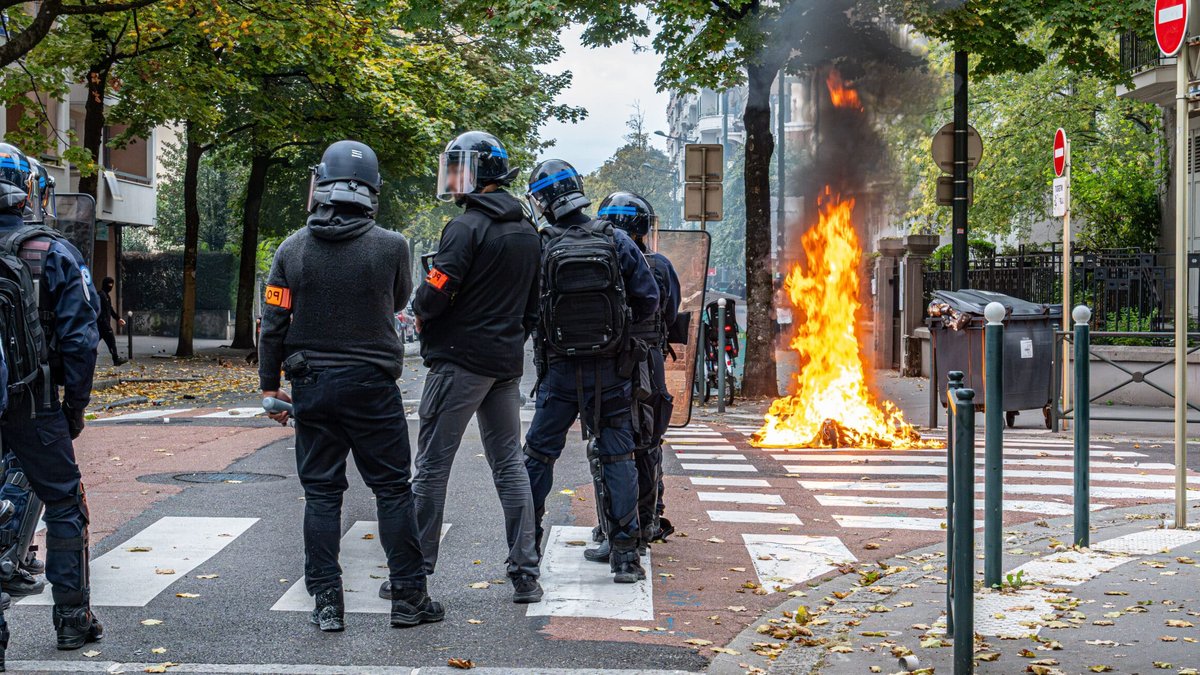
On October 17, 2026, violent protests in France reignited scrutiny of the état d’urgence law, a legal tool designed to address civil unrest. Originally enacted on April 3, 1955, during Algeria’s war of independence, the law has evolved into a permanent mechanism for managing public order crises. Over seven decades, it has been applied across various social unrest events, from 1961 to 2015, with recent activations in New Caledonia in 2024.
The Law’s Historical Evolution
The état d’urgence law emerged to suppress dissent during Algeria’s struggle for independence. Its provisions permitted authorities to restrict movement, conduct searches, and dissolve groups without judicial oversight. Despite Algeria gaining independence in 1962, the law persisted in France. It was deployed during the 1961 Algerian coup, in New Caledonia in 1985, and during urban riots in 2005. Following terrorist attacks in 2015, it was extended multiple times with amendments broadening its scope. Today, it functions as an ordinary law, unanchored in the Constitution, enabling officials to impose sweeping restrictions during crises.
Legal experts observe the law’s territorial focus. It may be declared in specific regions, such as urban centers or overseas territories, but not nationwide without local justification. This territorial specificity explains its frequent deployment in places like New Caledonia, where unrest over a citizenship vote in 2024 triggered its activation. Applications in mainland France during the October 17 protests raised concerns, as authorities detained over 2,400 individuals, including 855 in Paris alone, after clashes injured 150 police officers and damaged public buildings.
Post-Protest Debates and Government Response
The government’s refusal shows ongoing legal debates. Judicial challenges have moderated its use; the Constitutional Council invalidated provisions allowing warrantless data seizures in 2016 and limiting freedom of movement in 2017. These rulings highlight the judiciary’s role in checking executive overreach, though enforcement remains contentious.
Legal scholars emphasize the law’s reliance on administrative discretion rather than judicial review. While the judiciary can challenge measures post-facto, the initial decision rests with prefects and the Interior Ministry. This dynamic mirrors debates around Article 16, which centralizes emergency powers in the presidency.
On October 17, the government relied on standard policing and emergency legislation rather than invoking the état d’urgence. Prosecutors have since charged over 1,000 individuals, with penalties ranging from fines to prison terms. The incident reflects persistent tensions between public safety and civil rights-a struggle deeply embedded in France’s post-war legal framework. For now, the law remains dormant, but its shadow looms over future unrest.
Territorial Application and Legal Evolution
The état d’urgence law functions as a territorialized legal instrument, applicable to specific regions rather than nationwide without justification. The law’s territorial focus is codified in Article 15, which historically limited its scope to Algeria and six months, a provision later abolished in 2011. Today, it can be declared in metropolitan France, overseas departments, and territories under Article 74 of the Constitution, provided imminent threats to public order exist.
The law’s application has evolved through legislative amendments, particularly after the 2015 terrorist attacks. Between November 2015 and February 2018, it was extended multiple times, with new provisions like Articles 4-1, 6-1, and 8-1 added to address security concerns. The consolidated 2018 version now reflects judicial oversight, ensuring measures align with proportionality and necessity principles.
Court Controls and the 2026 Protests
Post-protest debates revealed the law’s constitutional ambiguities. The Conseil d’État, in a landmark 2025 ruling, annulled a TikTok blocking order in New Caledonia, emphasizing that such measures require strict judicial control. The court held that the law’s territorial application must respect fundamental freedoms, even during crises. This decision reinforced the principle that administrative authorities cannot exceed the law’s bounds without judicial validation, even under exceptional circumstances.
Administrative Authority and Emergency Powers
The law grants prefects the authority to prohibit the movement of persons and vehicles and forbid the presence of individuals deemed a threat to public order under article 5. The Interior Ministry may assign residence restrictions, mandate periodic police check-ins up to three times daily, retain passports, and ban contact with designated individuals via article 6. Article 6-1 permits the dissolution of associations by decree, while article 8 allows closure of entertainment venues, bars, meeting spaces, and places of worship, alongside prohibiting demonstrations and assemblies.
Emergency provisions extend to weapon confiscation, administrative seizures, and, with specific authorization, nighttime searches and data retention under article 11. Overseas territories like Mayotte first applied these rules in 2023 following a 2022 decentralization law, revealing a legal framework developed for other crises being repurposed for regional emergencies.


